
Light & Materials / GUIDE 19
Apartment Interior Design Abu Dhabi: Materials for Busy Households
Compare apartment interior materials in Abu Dhabi by everyday wear, cleaning, repairability and the needs of the household using each room.
The essential idea
Choose materials by the conditions they will face and the care the household can provide. Compare appearance alongside cleaning requirements, likely wear, repair options and installation details. Review samples and product information for the actual specification rather than relying on broad labels such as premium or maintenance-free.
A material can be beautiful and still be wrong for a particular home. A highly polished surface may reveal marks the resident dislikes, while a delicate fabric may be inconvenient in a frequently used family room. Apartment Interior Design Abu Dhabi should connect the palette to real behaviour. The best material choice is one the household can comfortably live with and maintain.
Map the likely wear
Consider how each surface is touched, cleaned and exposed. An entrance floor, dining tabletop and bedroom headboard experience different forms of use. Avoid specifying one material everywhere simply to make the apartment visually consistent.
Ask about the household's routines: children making things at the table, pets using the sofa, frequent cooking or regular visitors. These details help define the performance questions that should be put to suppliers.
Read beyond the material name
Natural stone, engineered surfaces, timber, laminate and upholstery each cover many different products. A broad category does not describe the finish, construction, treatment or care requirements of a particular item.
Request information for the exact specification being considered. Where performance matters, ask for relevant documented product data and suitable professional advice. Do not treat a salesperson's general statement as a substitute for the actual product requirements.
Compare cleaning expectations
Discuss what ordinary maintenance involves and which products or methods should be avoided. Some residents are comfortable with surfaces that change through use; others want a more consistent appearance. Neither preference is wrong, but it should be explicit.
| Question | Why it matters |
|---|---|
| How is routine dirt removed? | Determines everyday effort |
| What causes staining or damage? | Reveals likely household conflicts |
| Can a small area be repaired? | Affects future disruption |
| Are replacement parts available? | Helps with long-term maintenance |
| Does the finish change with use? | Sets realistic visual expectations |
Consider edges and junctions
Material performance depends partly on how it is detailed and installed. Exposed edges, corners, joints and transitions can become the most vulnerable areas. Review these details instead of approving only a large flat sample.
Ask how adjoining materials meet and how movement or maintenance will be accommodated where relevant. A tidy appearance should not rely on details that make later repair unnecessarily destructive.
Use samples for the right questions
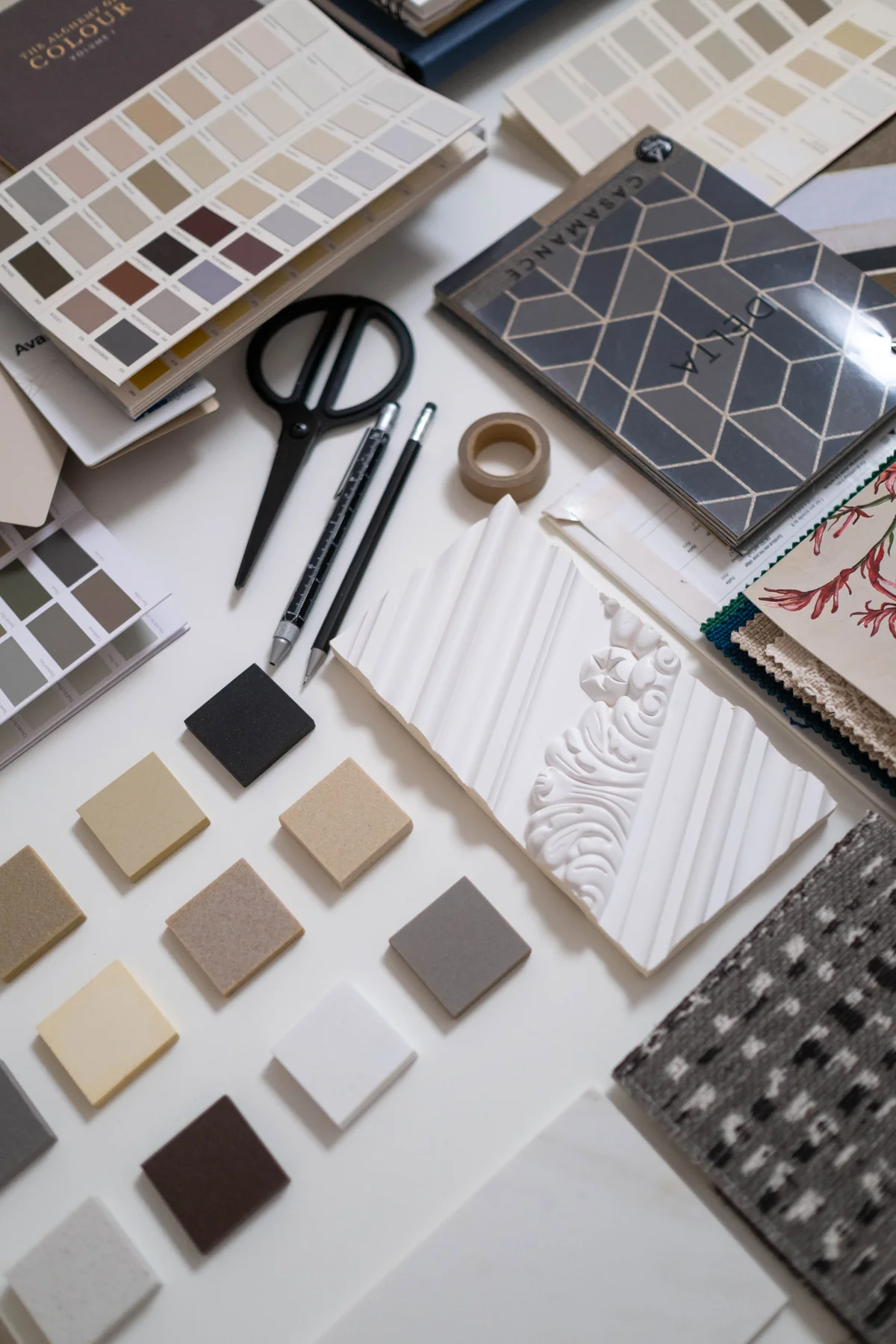
Samples help assess colour, texture and feel, but they do not prove every performance claim. Handle them under the room's lighting and compare them with surrounding finishes. Ask suppliers which demonstrations or tests are appropriate rather than improvising damaging experiments.
For upholstery, sit on the actual furniture where possible. Fabric colour, cushion construction and seating comfort work together. A suitable textile cannot compensate for a seat that does not fit the user.
Keep a record for future care
Retain product names, finish references, cleaning guidance and installation information. Label spare materials where retaining them is practical, and record where each specification was used. This makes later repair more straightforward.
Review the palette as a complete maintenance commitment before ordering. A busy household benefits from a small set of well-understood materials more than a collection of impressive samples with conflicting care needs. Durability is useful when it is matched to the way the apartment is actually lived in.
Common questions
Is natural stone always more practical than an engineered surface?
No. Suitability depends on the specific stone or product, its finish, the application and the household's expectations. Compare documented care and performance information for the actual options. The material category alone cannot decide the answer.
Should a family apartment avoid all light-coloured fabrics?
Not necessarily. Review the exact fabric, construction and care requirements alongside the household's routines. A suitable pale fabric may be practical, while a darker delicate fabric may still be demanding. Ask for product-specific guidance and realistic maintenance expectations.